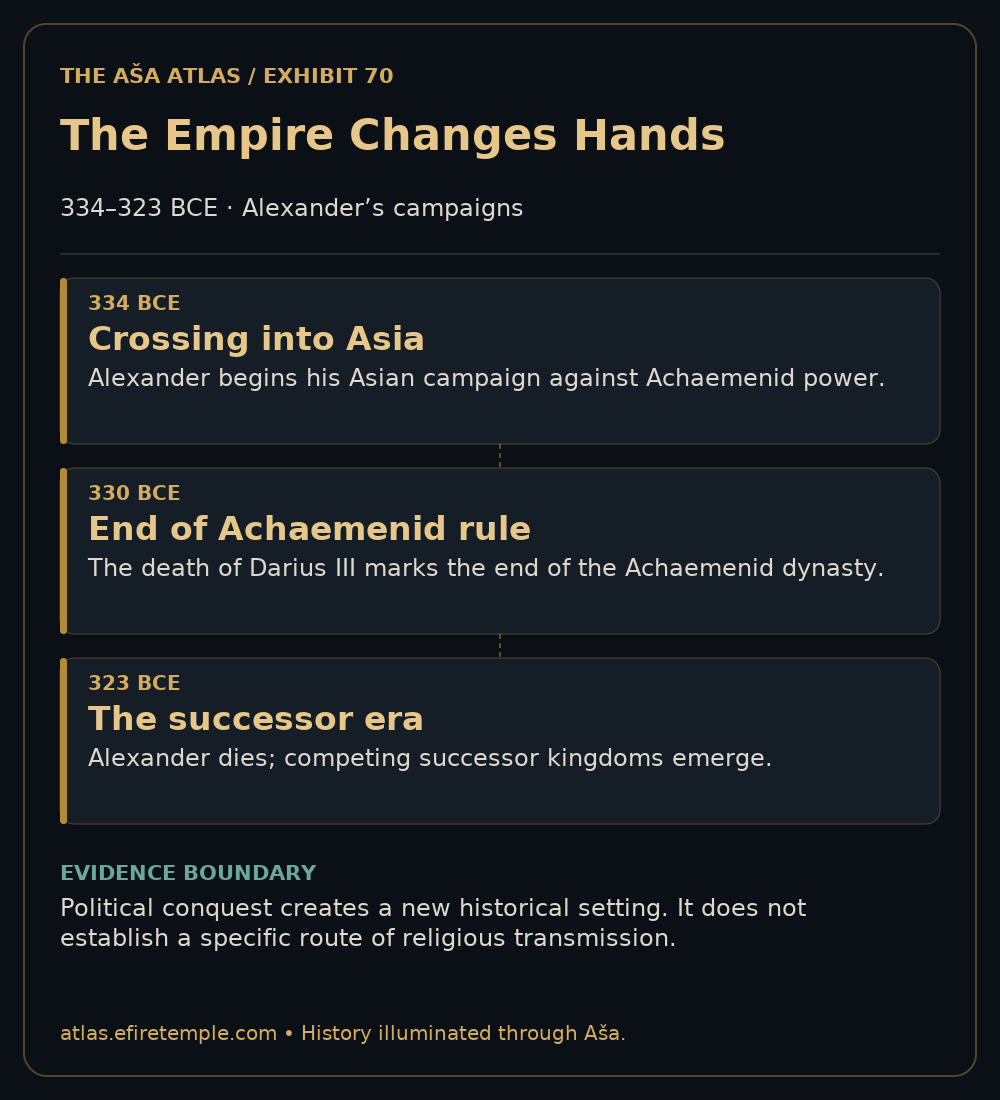
The Empire Changes Hands ↗
334–323 BCE · Alexander’s campaigns
Political conquest creates a new historical setting. It does not establish a specific route of religious transmission.
Trace references ↗From Persian sovereignty to a multilingual Hellenistic world. Examine historical contact, surviving manuscripts and the Greek vocabulary available before John.
Conquest, translation, manuscript preservation and literary influence are distinct. The Septuagint is a developing collection, not one third-century translation. Shared Greek vocabulary cannot by itself establish an Iranian loan.
334–323 BCE · Alexander’s campaigns
Political conquest creates a new historical setting. It does not establish a specific route of religious transmission.
Trace references ↗
After 323 BCE · successor kingdoms
Greek did not instantly replace Aramaic, Iranian languages or other local languages. Cultural exchange was uneven.
Trace references ↗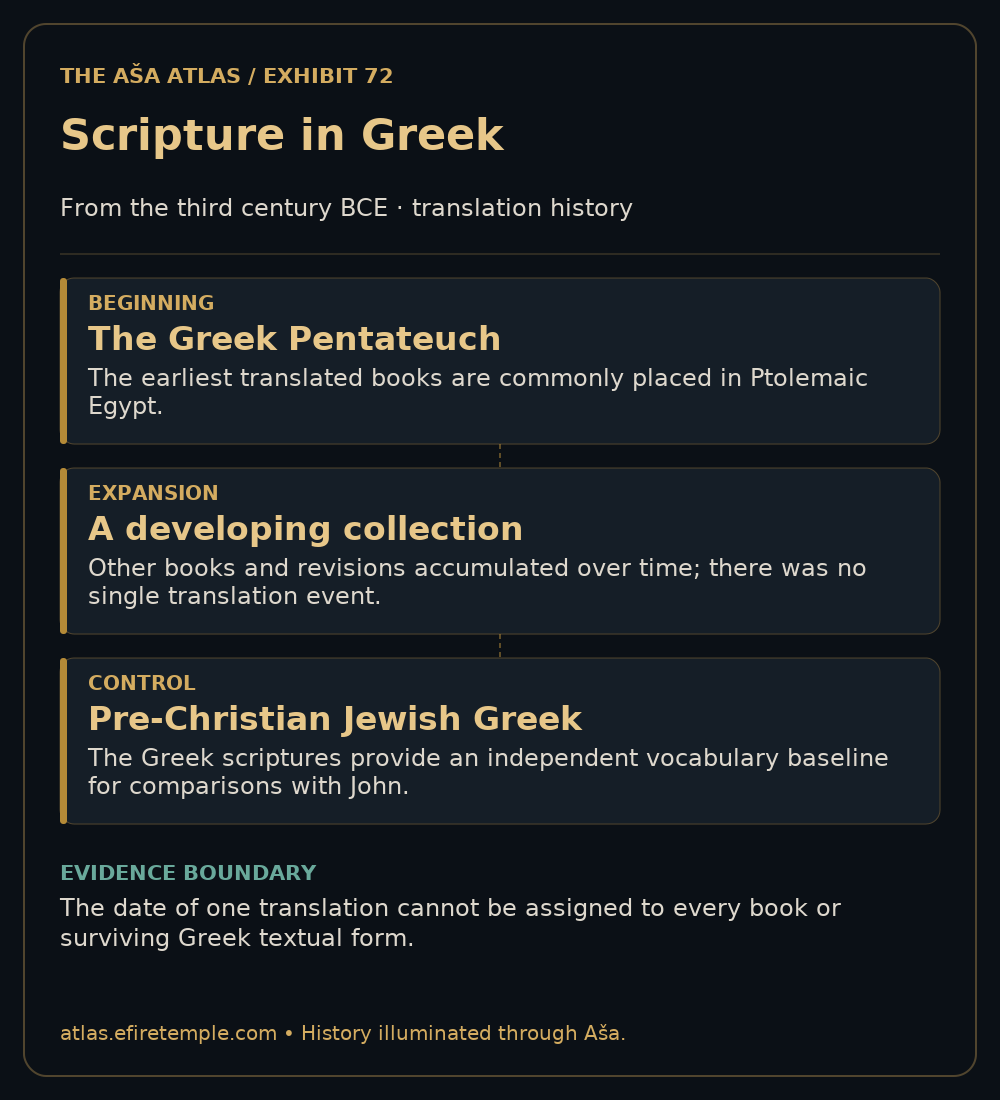
From the third century BCE · translation history
The date of one translation cannot be assigned to every book or surviving Greek textual form.
Trace references ↗
Greek P 458 · second century BCE (usual dating)
Catalogue identification is documented. No photograph or fresh diplomatic transcription is reproduced.
Trace references ↗
Genesis 1:1–5 LXX · John 1:1–5
Shared terms and the opening phrase support a Jewish Greek control. They cannot independently establish an Iranian loan or its absence.
Trace references ↗
Psalm 118:105,160 LXX · John 17:17
These are normalized lexical comparisons, not a claim that John quotes this psalm directly or that the terms are Persian calques.
Trace references ↗