
The Father Sent Life ↗
John 3:17 · 10:10 · 18:37
Life and testimony are explicit purposes, not proof that death had no role in the mission. Aša is a comparative framework, not an identified source.
Trace references ↗Are human killing, divine mission and atoning purpose identical?
Revelation, victory, substitution and sacrifice can coexist; early pre-Pauline tradition complicates a late-invention claim.
Truth and life are explicit mission themes; voluntary death and sacrificial imagery are also present. Aša provides a comparative lens on truth confronting falsehood and death.
Open the comparative study ↗John 3:17 · 10:10 · 18:37
Life and testimony are explicit purposes, not proof that death had no role in the mission. Aša is a comparative framework, not an identified source.
Trace references ↗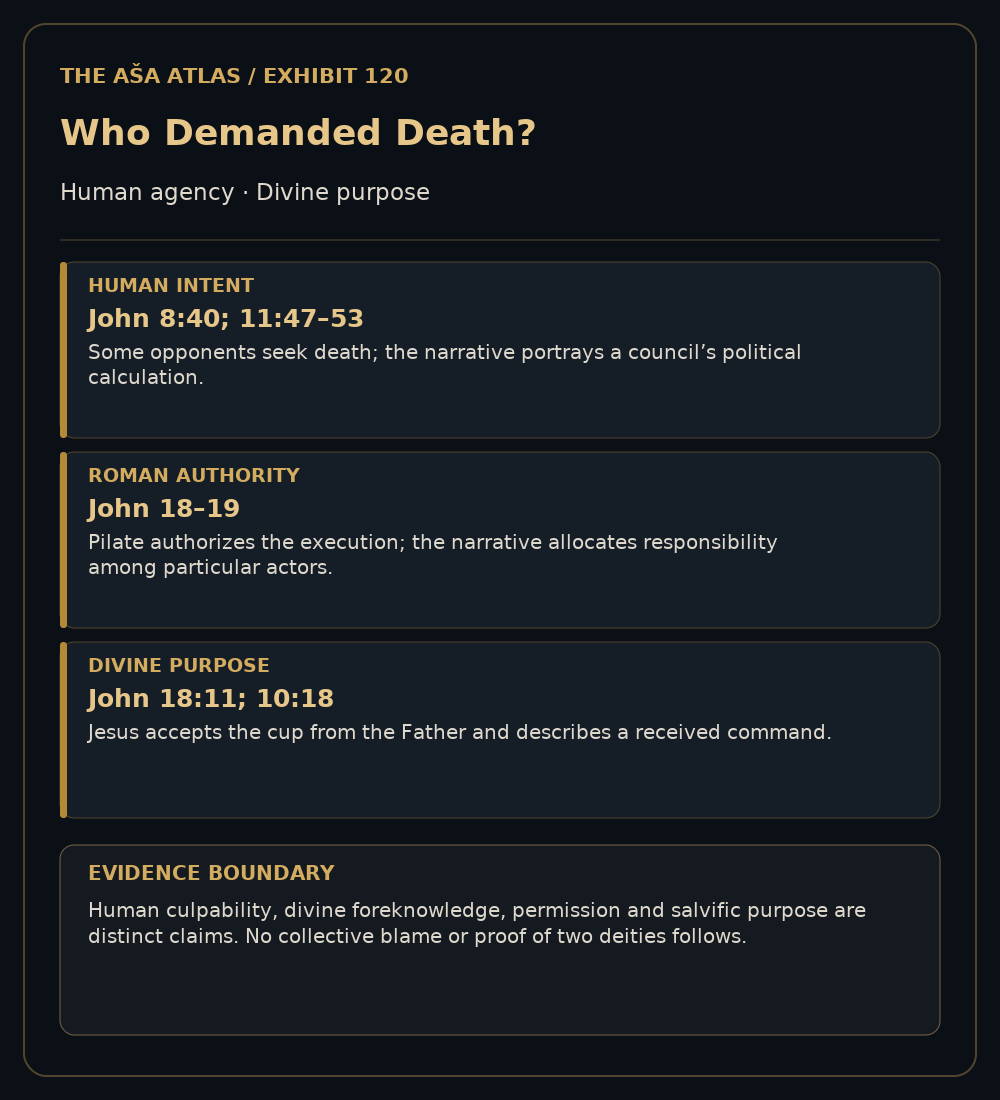
Human agency · Divine purpose
Human culpability, divine foreknowledge, permission and salvific purpose are distinct claims. No collective blame or proof of two deities follows.
Trace references ↗
Mercy · Atonement
Earlier forgiveness challenges a simplistic temporal blood-payment model but does not disprove every atonement theory. Synoptic evidence is not Johannine authorship.
Trace references ↗
Aša · Death · Life
Triumph, revelation and sacrifice can coexist in Christian readings. The proposed Aša model is interpretive, not proof of transmission or exclusive historical intent.
Trace references ↗