
Salvation: Origin Is Not Identity ↗
John 4:22 · Greek syntax
The normal translation is salvation is from the Jews/Judeans, not rescue from them or they need saving. The verse supports Jewish continuity but does not name Yahweh.
Trace references ↗Does John 4:22 determine the divine sender?
Jewish revelation and continuity are supported by the worshipping we in John 4:22.
Greek syntax identifies source; John 5:34 identifies recipients; 1 John 4:14 identifies the sender. The dossier distinguishes historical origin from divine identity.
Open the comparative study ↗Romans 1:16 identifies recipients; Romans 10:1 and 11:11–14 show Paul’s concern for Israel and the Gentiles. Romans 11:26–29 retains Israel’s calling. Luke 19:9–10 identifies a son of Abraham as a recipient of salvation.
Luke 1:71 uses the same noun and preposition as John 4:22 in a different contextual construction: deliverance from enemies. It does not authorize translating John as rescue from Jews. Luke 1:68–79 also affirms Israel’s covenant and Davidic promise.
Matthew 10:5–6 and 15:24 identify the initial mission. Acts 3:13, 26 and 5:30–31 also identify the ancestral God in their later narrative theology. Examine both recipient and continuity evidence.
Open the complete mission audit ↗ Shepherd and prophetic controls ↗John 4:22 · Greek syntax
The normal translation is salvation is from the Jews/Judeans, not rescue from them or they need saving. The verse supports Jewish continuity but does not name Yahweh.
Trace references ↗
John 5:34–47 · Recipients
Some Jewish interlocutors are recipients of salvation; this is not an ethnic indictment or a retranslation of John 4:22.
Trace references ↗
1 John 4:14 · John 4:42
Distinct roles do not prove different divine identities. The relationship between Gospel and epistle is a literary question; common authorship is not assumed.
Trace references ↗
John 8 and 16 · Allegiance
The Father-of-Aša reading tests distinct referents against a same-God/false-knowledge reading. Do not assign collective guilt or spiritual status to Jewish people.
Trace references ↗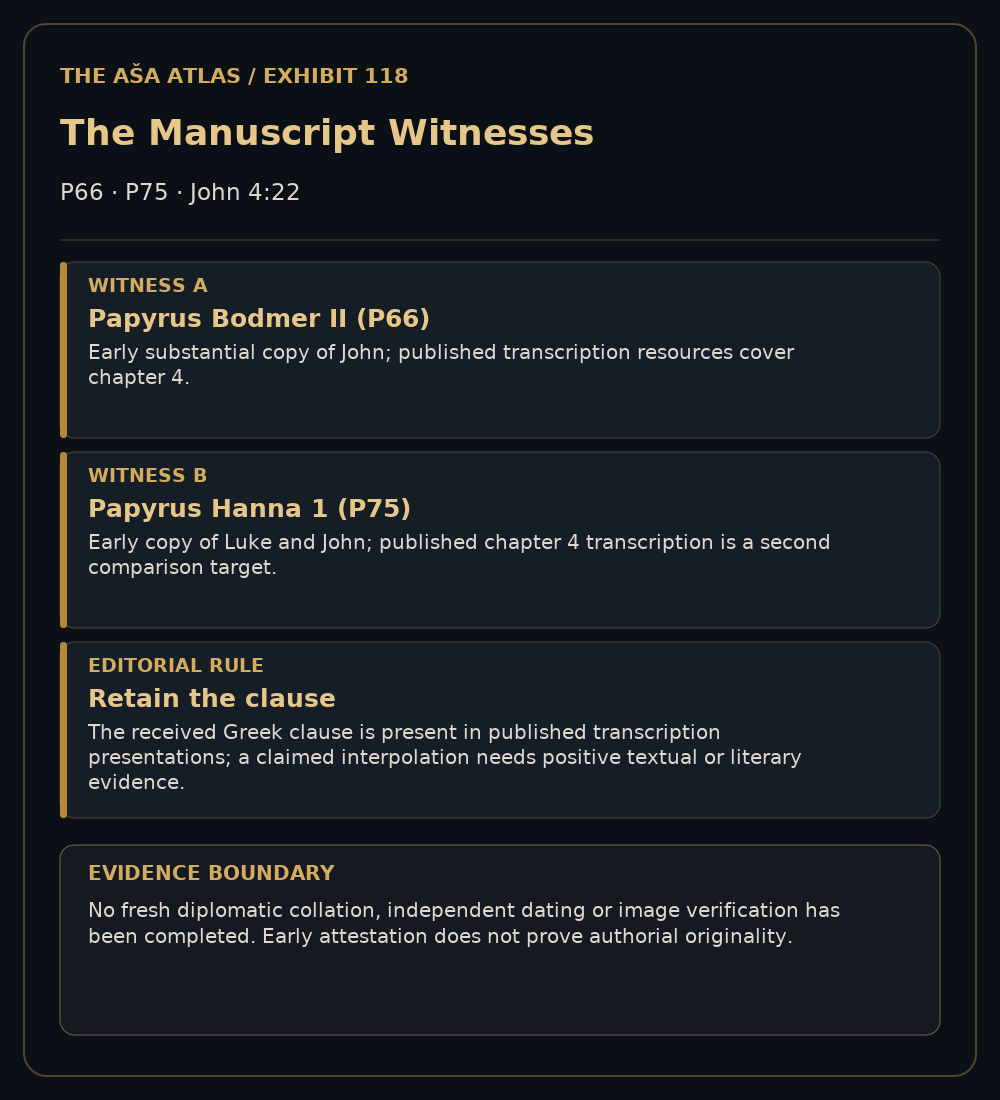
P66 · P75 · John 4:22
No fresh diplomatic collation, independent dating or image verification has been completed. Early attestation does not prove authorial originality.
Trace references ↗