RUN 08 / THE THEOLOGICAL COMPARISON ENGINE
← Theology research center
Sources, atonement and competing identity models
Which readings are supported, which remain competing hypotheses, and what could change the result?
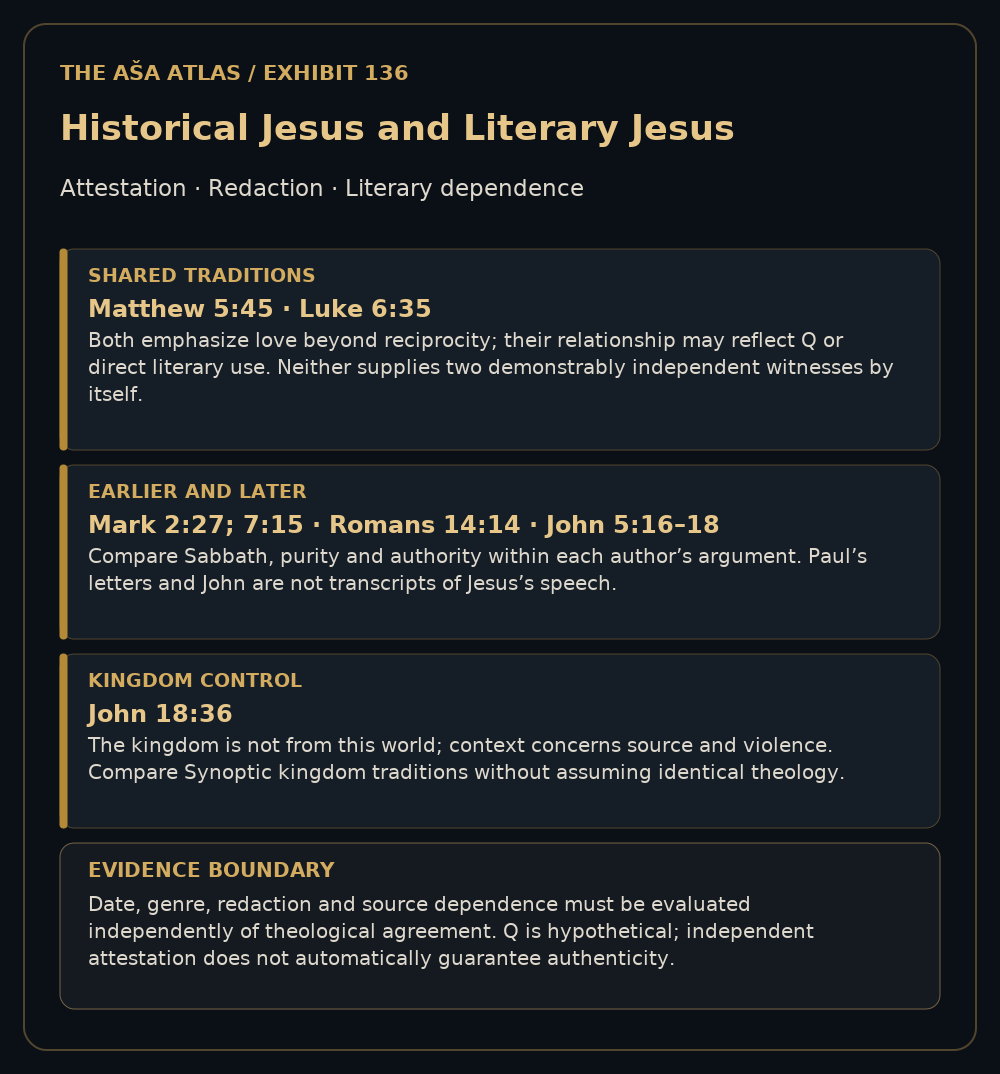
01Matthew 5:45 · Luke 6:35Evidence and hypotheses
02Mark 2:27; 7:15 · Romans 14:14 · John 5:16–18Evidence and hypotheses
03John 18:36Evidence and hypotheses
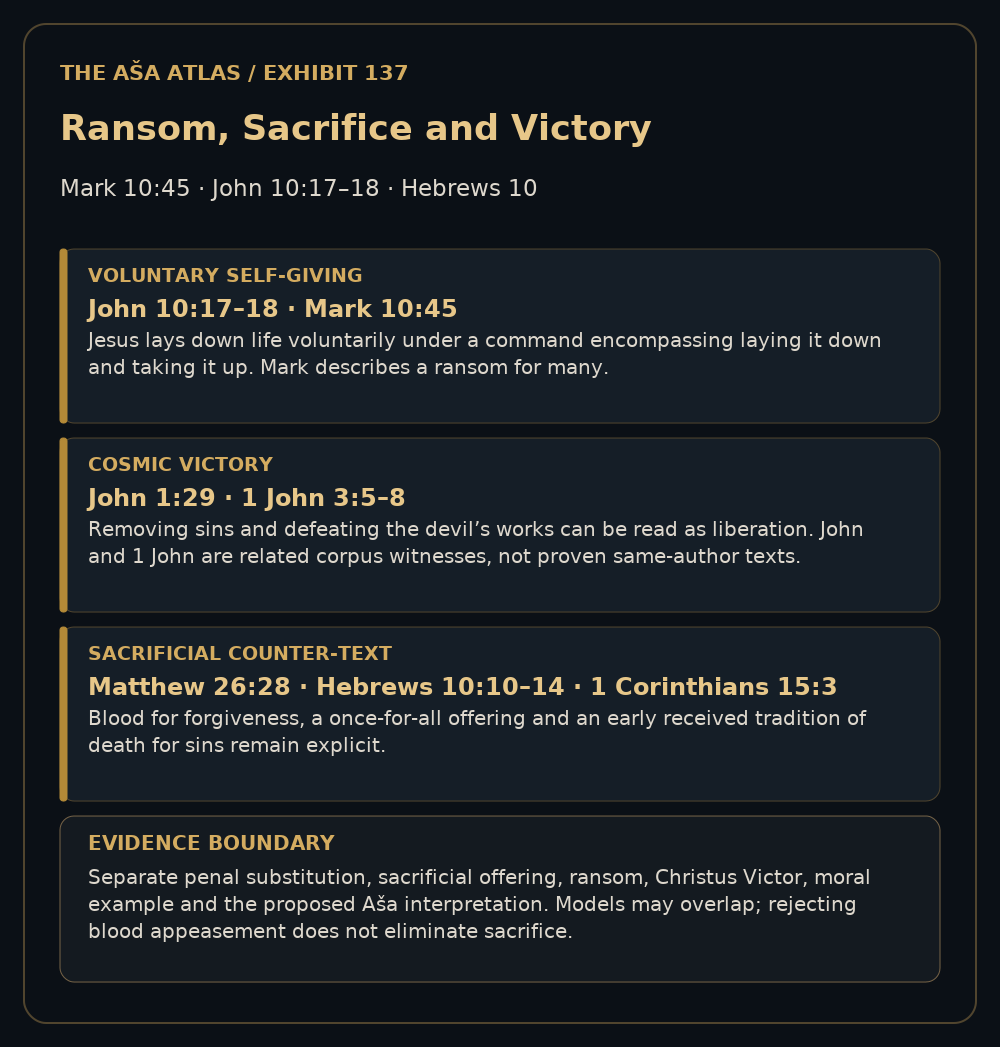
04John 10:17–18 · Mark 10:45Evidence and hypotheses
05John 1:29 · 1 John 3:5–8Evidence and hypotheses
06Matthew 26:28 · Hebrews 10:10–14 · 1 Corinthians 15:3Evidence and hypotheses
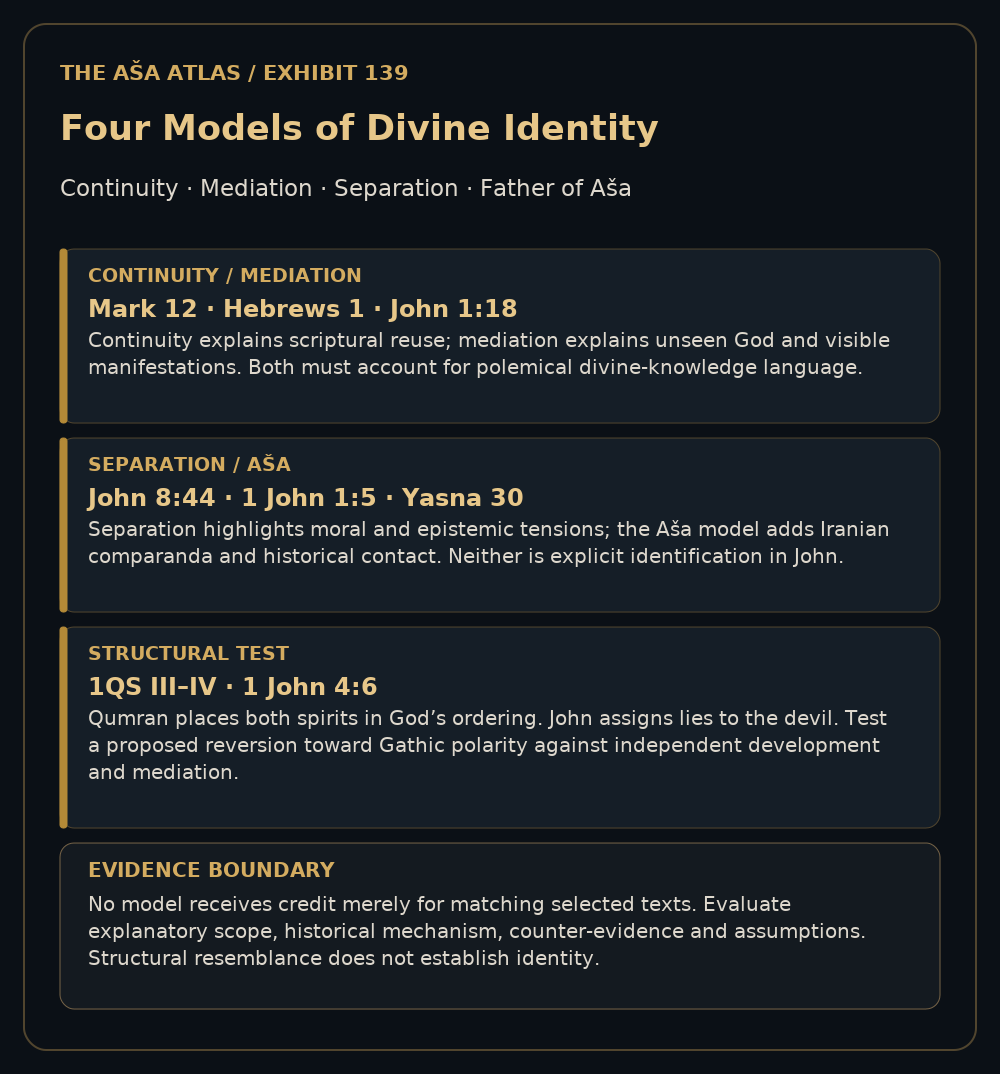
07Mark 12 · Hebrews 1 · John 1:18Evidence and hypotheses
08John 8:44 · 1 John 1:5 · Yasna 30Evidence and hypotheses
091QS III–IV · 1 John 4:6Evidence and hypotheses
10Earlier or closer alternativesEvidence and hypotheses
11Specific transmissionEvidence and hypotheses
12Counter-texts and negative evidenceEvidence and hypotheses
Read the witnesses
Evidence and hypotheses / Textual observation
Matthew 5:45 · Luke 6:35
Both emphasize love beyond reciprocity; their relationship may reflect Q or direct literary use. Neither supplies two demonstrably independent witnesses by itself.
- Matthew 5 — text and notes ↗Reference located; targeted text or scholarly abstract used where available; independent collation and claim-support audit pending.
- Luke 6 — text and notes ↗Reference located; targeted text or scholarly abstract used where available; independent collation and claim-support audit pending.
- Mark 2 — text and notes ↗Reference located; targeted text or scholarly abstract used where available; independent collation and claim-support audit pending.
- Mark 7 — text and notes ↗Reference located; targeted text or scholarly abstract used where available; independent collation and claim-support audit pending.
- Romans 14 — text and notes ↗Reference located; targeted text or scholarly abstract used where available; independent collation and claim-support audit pending.
- John 5 — text and notes ↗Reference located; targeted text or scholarly abstract used where available; independent collation and claim-support audit pending.
- John 18 — text and notes ↗Reference located; targeted text or scholarly abstract used where available; independent collation and claim-support audit pending.
- The Enigma of the Antitheses (2023), New Testament Studies ↗Reference located; targeted text or scholarly abstract used where available; independent collation and claim-support audit pending.
Evidence and hypotheses / Textual observation
Mark 2:27; 7:15 · Romans 14:14 · John 5:16–18
Compare Sabbath, purity and authority within each author’s argument. Paul’s letters and John are not transcripts of Jesus’s speech.
- Matthew 5 — text and notes ↗Reference located; targeted text or scholarly abstract used where available; independent collation and claim-support audit pending.
- Luke 6 — text and notes ↗Reference located; targeted text or scholarly abstract used where available; independent collation and claim-support audit pending.
- Mark 2 — text and notes ↗Reference located; targeted text or scholarly abstract used where available; independent collation and claim-support audit pending.
- Mark 7 — text and notes ↗Reference located; targeted text or scholarly abstract used where available; independent collation and claim-support audit pending.
- Romans 14 — text and notes ↗Reference located; targeted text or scholarly abstract used where available; independent collation and claim-support audit pending.
- John 5 — text and notes ↗Reference located; targeted text or scholarly abstract used where available; independent collation and claim-support audit pending.
- John 18 — text and notes ↗Reference located; targeted text or scholarly abstract used where available; independent collation and claim-support audit pending.
- The Enigma of the Antitheses (2023), New Testament Studies ↗Reference located; targeted text or scholarly abstract used where available; independent collation and claim-support audit pending.
Evidence and hypotheses / Textual observation
John 18:36
The kingdom is not from this world; context concerns source and violence. Compare Synoptic kingdom traditions without assuming identical theology.
- Matthew 5 — text and notes ↗Reference located; targeted text or scholarly abstract used where available; independent collation and claim-support audit pending.
- Luke 6 — text and notes ↗Reference located; targeted text or scholarly abstract used where available; independent collation and claim-support audit pending.
- Mark 2 — text and notes ↗Reference located; targeted text or scholarly abstract used where available; independent collation and claim-support audit pending.
- Mark 7 — text and notes ↗Reference located; targeted text or scholarly abstract used where available; independent collation and claim-support audit pending.
- Romans 14 — text and notes ↗Reference located; targeted text or scholarly abstract used where available; independent collation and claim-support audit pending.
- John 5 — text and notes ↗Reference located; targeted text or scholarly abstract used where available; independent collation and claim-support audit pending.
- John 18 — text and notes ↗Reference located; targeted text or scholarly abstract used where available; independent collation and claim-support audit pending.
- The Enigma of the Antitheses (2023), New Testament Studies ↗Reference located; targeted text or scholarly abstract used where available; independent collation and claim-support audit pending.
Evidence and hypotheses / Textual observation
John 10:17–18 · Mark 10:45
Jesus lays down life voluntarily under a command encompassing laying it down and taking it up. Mark describes a ransom for many.
- John 10 — text and notes ↗Reference located; targeted text or scholarly abstract used where available; independent collation and claim-support audit pending.
- Mark 10 — text and notes ↗Reference located; targeted text or scholarly abstract used where available; independent collation and claim-support audit pending.
Evidence and hypotheses / Textual observation
John 1:29 · 1 John 3:5–8
Removing sins and defeating the devil’s works can be read as liberation. John and 1 John are related corpus witnesses, not proven same-author texts.
- Mark 10 — text and notes ↗Reference located; targeted text or scholarly abstract used where available; independent collation and claim-support audit pending.
- John 1 — text and notes ↗Reference located; targeted text or scholarly abstract used where available; independent collation and claim-support audit pending.
- John 10 — text and notes ↗Reference located; targeted text or scholarly abstract used where available; independent collation and claim-support audit pending.
- Matthew 26 — text and notes ↗Reference located; targeted text or scholarly abstract used where available; independent collation and claim-support audit pending.
- Hebrews 10 — text and notes ↗Reference located; targeted text or scholarly abstract used where available; independent collation and claim-support audit pending.
- 1Corinthians 15 — text and notes ↗Reference located; targeted text or scholarly abstract used where available; independent collation and claim-support audit pending.
- 1John 3 — text and notes ↗Reference located; targeted text or scholarly abstract used where available; independent collation and claim-support audit pending.
Evidence and hypotheses / Textual observation
Matthew 26:28 · Hebrews 10:10–14 · 1 Corinthians 15:3
Blood for forgiveness, a once-for-all offering and an early received tradition of death for sins remain explicit.
- Matthew 26 — text and notes ↗Reference located; targeted text or scholarly abstract used where available; independent collation and claim-support audit pending.
- Hebrews 10 — text and notes ↗Reference located; targeted text or scholarly abstract used where available; independent collation and claim-support audit pending.
- 1Corinthians 15 — text and notes ↗Reference located; targeted text or scholarly abstract used where available; independent collation and claim-support audit pending.
Evidence and hypotheses / Textual observation
Mark 12 · Hebrews 1 · John 1:18
Continuity explains scriptural reuse; mediation explains unseen God and visible manifestations. Both must account for polemical divine-knowledge language.
- Mark 12 — text and notes ↗Reference located; targeted text or scholarly abstract used where available; independent collation and claim-support audit pending.
- Hebrews 1 — text and notes ↗Reference located; targeted text or scholarly abstract used where available; independent collation and claim-support audit pending.
- John 1 — text and notes ↗Reference located; targeted text or scholarly abstract used where available; independent collation and claim-support audit pending.
- John 8 — text and notes ↗Reference located; targeted text or scholarly abstract used where available; independent collation and claim-support audit pending.
- 1John 1 — text and notes ↗Reference located; targeted text or scholarly abstract used where available; independent collation and claim-support audit pending.
- 1John 4 — text and notes ↗Reference located; targeted text or scholarly abstract used where available; independent collation and claim-support audit pending.
- Iranica — Dualism ↗Reference located; targeted text or scholarly abstract used where available; independent collation and claim-support audit pending.
- Collins and Nati (2024), Instruction on the Two Spirits ↗Reference located; targeted text or scholarly abstract used where available; independent collation and claim-support audit pending.
- Qumran-Digital — 1QS transcription ↗Reference located; targeted text or scholarly abstract used where available; independent collation and claim-support audit pending.
- Iranica — Gathas ii: Translations ↗Reference located; targeted text or scholarly abstract used where available; independent collation and claim-support audit pending.
Evidence and hypotheses / Textual observation
John 8:44 · 1 John 1:5 · Yasna 30
Separation highlights moral and epistemic tensions; the Aša model adds Iranian comparanda and historical contact. Neither is explicit identification in John.
- Mark 12 — text and notes ↗Reference located; targeted text or scholarly abstract used where available; independent collation and claim-support audit pending.
- Hebrews 1 — text and notes ↗Reference located; targeted text or scholarly abstract used where available; independent collation and claim-support audit pending.
- John 1 — text and notes ↗Reference located; targeted text or scholarly abstract used where available; independent collation and claim-support audit pending.
- John 8 — text and notes ↗Reference located; targeted text or scholarly abstract used where available; independent collation and claim-support audit pending.
- 1John 1 — text and notes ↗Reference located; targeted text or scholarly abstract used where available; independent collation and claim-support audit pending.
- 1John 4 — text and notes ↗Reference located; targeted text or scholarly abstract used where available; independent collation and claim-support audit pending.
- Iranica — Dualism ↗Reference located; targeted text or scholarly abstract used where available; independent collation and claim-support audit pending.
- Collins and Nati (2024), Instruction on the Two Spirits ↗Reference located; targeted text or scholarly abstract used where available; independent collation and claim-support audit pending.
- Qumran-Digital — 1QS transcription ↗Reference located; targeted text or scholarly abstract used where available; independent collation and claim-support audit pending.
- Iranica — Gathas ii: Translations ↗Reference located; targeted text or scholarly abstract used where available; independent collation and claim-support audit pending.
Evidence and hypotheses / Comparative observation
1QS III–IV · 1 John 4:6
Qumran places both spirits in God’s ordering. John assigns lies to the devil. Test a proposed reversion toward Gathic polarity against independent development and mediation.
- Mark 12 — text and notes ↗Reference located; targeted text or scholarly abstract used where available; independent collation and claim-support audit pending.
- Hebrews 1 — text and notes ↗Reference located; targeted text or scholarly abstract used where available; independent collation and claim-support audit pending.
- John 1 — text and notes ↗Reference located; targeted text or scholarly abstract used where available; independent collation and claim-support audit pending.
- John 8 — text and notes ↗Reference located; targeted text or scholarly abstract used where available; independent collation and claim-support audit pending.
- 1John 1 — text and notes ↗Reference located; targeted text or scholarly abstract used where available; independent collation and claim-support audit pending.
- 1John 4 — text and notes ↗Reference located; targeted text or scholarly abstract used where available; independent collation and claim-support audit pending.
- Iranica — Dualism ↗Reference located; targeted text or scholarly abstract used where available; independent collation and claim-support audit pending.
- Collins and Nati (2024), Instruction on the Two Spirits ↗Reference located; targeted text or scholarly abstract used where available; independent collation and claim-support audit pending.
- Qumran-Digital — 1QS transcription ↗Reference located; targeted text or scholarly abstract used where available; independent collation and claim-support audit pending.
- Iranica — Gathas ii: Translations ↗Reference located; targeted text or scholarly abstract used where available; independent collation and claim-support audit pending.
Evidence and hypotheses / Textual observation
Earlier or closer alternatives
Secure early Hebrew parallels or stronger Jewish Greek literary explanations would reduce the need for Iranian dependence; Gathic mismatches weaken structural correspondence.
Evidence and hypotheses / Textual observation
Specific transmission
An early Iranian technical loan, identifiable intermediary, or explicit ancient teaching linking John’s concepts to Mazda would strengthen dependence or identification.
Evidence and hypotheses / Textual observation
Counter-texts and negative evidence
Compare continuity, mediation, separation and Aša under the same criteria. Existing continuity texts matter; no new manuscript is required to weaken the model.
Evaluate the argument
OBSERVATION
Both emphasize love beyond reciprocity; their relationship may reflect Q or direct literary use. Neither supplies two demonstrably independent witnesses by itself. Jesus lays down life voluntarily under a command encompassing laying it down and taking it up. Mark describes a ransom for many.
EFIRETEMPLE INTERPRETATION
The Father-of-Aša proposal is examined through chronological priority, ethical and structural comparison, and documented opportunities for transmission.
ALTERNATIVE READING
Continuity, mediation, independent Jewish development and later reception remain competing explanations. Compare continuity, mediation, separation and Aša under the same criteria. Existing continuity texts matter; no new manuscript is required to weaken the model.
EVIDENCE BOUNDARY
Date, genre, redaction and source dependence must be evaluated independently of theological agreement. Q is hypothetical; independent attestation does not automatically guarantee authenticity. Separate penal substitution, sacrificial offering, ransom, Christus Victor, moral example and the proposed Aša interpretation. Models may overlap; rejecting blood appeasement does not eliminate sacrifice. No model receives credit merely for matching selected texts. Evaluate explanatory scope, historical mechanism, counter-evidence and assumptions. Structural resemblance does not establish identity. Chronological priority, structural similarity and dependence are separate hypotheses. No need to demand total sociological isolation or reversal of Gathic dating. Historical analysis cannot settle metaphysical identity by itself.
Visual and linguistic evidence
Language study: Two Spirits: subordination or structural reversion? ↗